Guide
Party wall basics for extensions
If your extension goes on or next to a boundary, or digs near a neighbour’s building, the Party Wall etc. Act 1996 may apply. This guide explains in plain terms what the Act covers, how notices and awards work, and what it means for your programme.
Last reviewed: 2 October 2026
This is general guidance, not legal advice. Whether the Act applies to your project, and what you must do, depends on the work and the neighbouring properties. Take advice from a party wall surveyor or a solicitor for your case.
Planning an extension?
Short answer
The Party Wall etc. Act 1996 gives a framework for preventing and resolving disputes when building work affects a shared wall, a boundary or the ground next to a neighbour’s building. If it applies, you (the building owner) must give your neighbours written notice before work starts, and they can agree or disagree. If they disagree, surveyors settle the terms in a document called an award. The Act is separate from planning permission and building regulations, and having those does not replace it.
What the Act covers
In plain terms, the Act applies to three kinds of work:
- Work to an existing party wall or party structure, for example cutting into it, raising it, rebuilding it or removing a chimney breast from it.
- New building on or at the boundary between two properties, for example a new wall built astride the line, or against it on your side.
- Digging near a neighbour’s building, for example excavating for new foundations within 3 metres or 6 metres of a neighbouring building, below the level of their foundations (the exact tests are in the GOV.UK booklet).
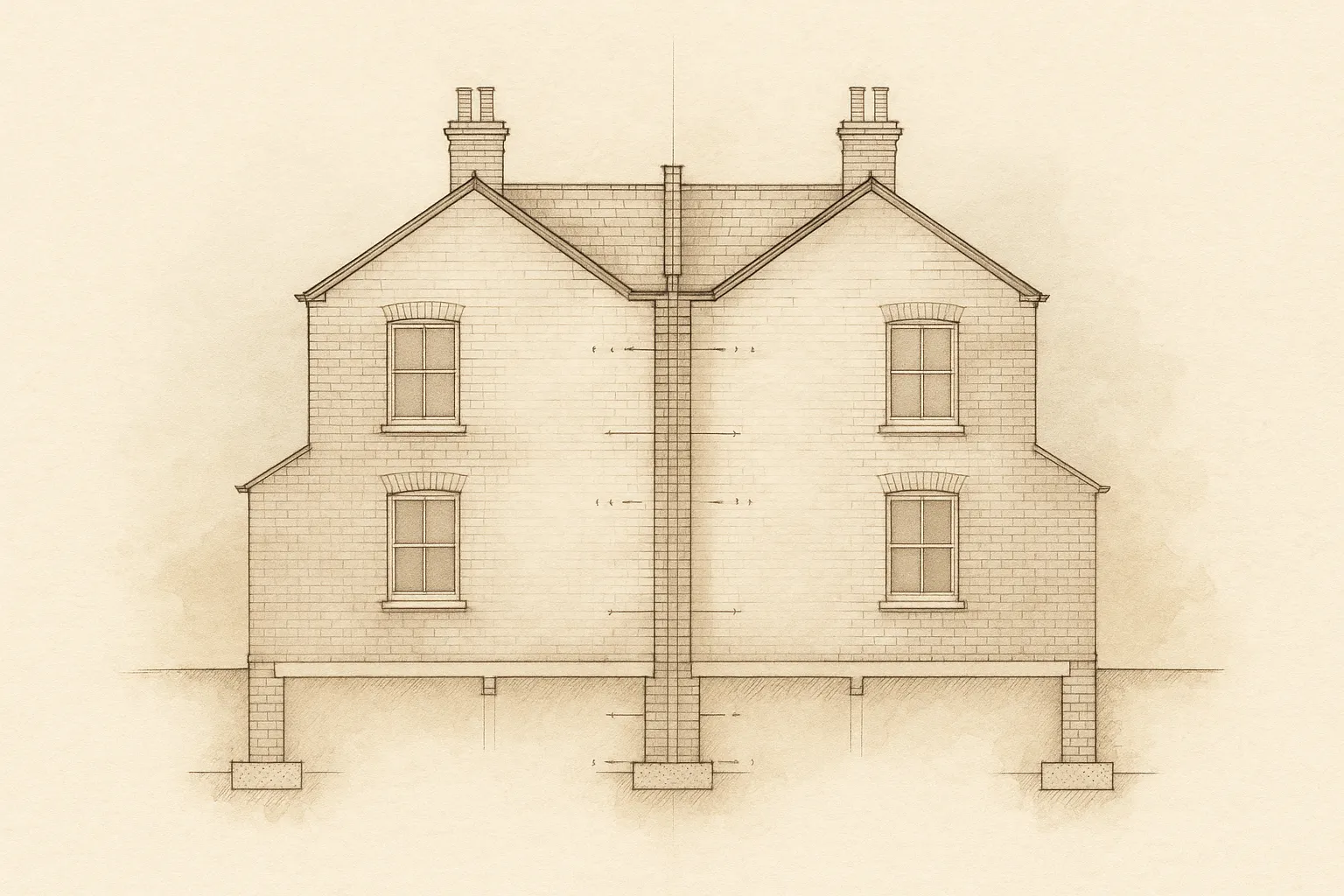
A party wall is usually a wall shared between two properties, such as the wall between two terraced or semi-detached houses. A garden wall that stands on the land of two owners can be one too. Timber fences are not.
Which extension work tends to trigger it
This is general, not a checklist for your house.
- Side-return extensions often involve a new wall on or beside the boundary and foundations near the neighbour’s house.
- Wrap-around extensions can involve more than one boundary.
- Rear extensions may involve it where the new walls or foundations are close to a neighbouring building, or where steel beams are set into a party wall.
- Loft work can involve it where beams bear on a party wall.
Your architect, structural engineer or a party wall surveyor can tell you whether the Act applies to your plans.
Notices: who serves them, and when
The building owner serves the notice. Notices are written and must give the details set out in the Act. GOV.UK publishes example letters you can use. They can be delivered in person, posted, or emailed if the recipient has agreed to that.
According to the GOV.UK explanatory booklet, the timings are:
- Notice for work to an existing party wall: generally at least two months before the work starts.
- Notice for a new wall at the boundary, or for excavation near a neighbouring building: generally at least one month before the work starts.
A notice is valid for a year, so do not serve it too long before you plan to start.
Your neighbour has 14 days from service to respond. They can consent in writing, refuse consent, or do nothing. If they do nothing for 14 days after you serve notice for work to an existing party wall, a dispute is treated as having arisen. They can also serve a counter-notice within one month asking for additional or modified work for their own benefit.
Tell your neighbours before the notice arrives. GOV.UK suggests a notice should not come as a surprise, and a friendly conversation first usually makes agreement easier.
Agreeing, or a dispute
If your neighbour consents in writing to the work as described, that can be the end of it. Agreements should be put in writing. If they dissent, or a dispute is treated as having arisen, the Act’s dispute procedure applies.
Surveyors and awards
When there is a dispute, the Act asks the owners to appoint surveyors who produce an award:
- One agreed surveyor, chosen by both owners, can act for both of you, or
- Each owner can appoint their own surveyor, and the two surveyors select a third who is called in only if they cannot agree.
Surveyors must act impartially and consider the interests of both owners. If a neighbour will not appoint a surveyor, the Act allows the building owner to appoint one on their behalf so the process can continue.
The award is a legal document. It sets out what work may be done, how and when it is to be carried out, and who pays the costs. It is final and binding unless a county court rescinds or modifies it on appeal, and the appeal period is 14 days from service of the award.
Usually the building owner pays the reasonable costs of drawing up the award, including the adjoining owner’s surveyor, where the work is for the building owner’s benefit. There are no set surveyor fees. If you think a charge is unreasonable you can ask for a breakdown.
A schedule of condition records the state of the neighbour’s property before work begins, usually in writing with photographs. It is not required by the Act, but GOV.UK describes it as prudent, because without one it can be hard to prove that damage was caused by the work.
How it fits the build programme
The notice period, any dispute and the award all come before work on the affected parts can begin. That means party wall steps need to be planned alongside design, planning and building regulations, not left until the builder is ready to start. We do not quote a typical duration, because it depends on your neighbours and the work. Ask your surveyor for their expectation for your case.
How we help
We coordinate with your neighbours as part of the project, and can arrange a party wall surveyor we work with regularly, or recommend one, with their fees passed on at cost. We do not give legal advice, and we recommend you take advice from a party wall surveyor.
Party walls are separate from planning and building regulations
Planning permission covers whether the development can go ahead. Building regulations cover how it is built. The Party Wall etc. Act covers your relationship with neighbours whose property is affected. You may need all three.
Frequently asked questions
Do I need a party wall surveyor?
Not always. If your neighbour consents in writing to the work, you may not need one. If they disagree or do not respond, the Act’s dispute process involves surveyors. A surveyor can also tell you whether the Act applies to your plans.
Who serves the notice?
The building owner, which means you as the person having the work done. We coordinate with your neighbours as part of the project, and can arrange a party wall surveyor we work with regularly, or recommend one, with their fees passed on at cost.
How far ahead do I have to give notice?
According to GOV.UK, generally at least two months before work to an existing party wall, and at least one month for a new boundary wall or for excavation near a neighbouring building. A notice is valid for a year.
Who pays for the surveyors?
Usually the building owner pays the reasonable costs of the award, including the neighbour’s surveyor, where the work is for the building owner’s benefit. The award sets out who pays. There are no set fees.
Can my neighbour stop my extension?
Your neighbour can disagree with your notice, which starts the surveyor process, and the award can set conditions on how and when the work is done. If you start work without proper notice, your neighbour may seek an injunction or other legal remedy. Take advice for your case.
Does planning permission cover party wall matters?
No. They are separate. Having planning permission does not replace party wall notices.